A presentation on how to use websites to further your research, with practical examples – click to run
A census has taken place in England and Wales every 10 years since 1801 (with the exception of 1941). The first four of these generated largely statistical returns, but some census enumerators also listed names of householders and occasionally those of their families. [Binfield’s 1801 census is a Berkshire example.]
The first census of real and universal significance for family historians was taken on the night of Sunday, June 6 1841. Names were recorded of everyone resident in each property, starting with the head of household. In many cases, even vagrants and those living rough in tents were also recorded. But there is little doubt that in the summer of 1841, significant numbers of people were missed. The information on this census is quite limited, and ages of adults were invariably rounded downwards, making interpretation difficult in some cases.
The next census taken on the night of Sunday, March 30, 1851 was a much grander affair, and far more useful for family historians. Around 30,000 enumerators collected 4.3 million schedules. These were eventually transcribed, into 38,000 books. The precise dates of the England and Wales censuses were:
| 1801 Census | Tuesday 10th March 1801 | Limited information, and only available where the lists of individuals have been kept |
| 1811 Census | Monday 27th May 1811 | Limited information, and only available where the lists of individuals have been kept |
| 1821 Census | Monday 28th May 1821 | Limited information, and only available where the lists of individuals have been kept |
| 1831 Census | Sunday 29th May 1831 | Limited information, and only available where the lists of individuals have been kept |
| 1841 Census | Sunday 6th June 1841 | Complete, widely published and available online with Findmypast, The Genealogist etc — but contains limited detail on individuals |
| 1851 Census | Sunday 30th March 1851 | Complete, widely published and available online with Findmypast, The Genealogist etc |
| 1861 Census | Sunday 7th April 1861 | Complete, widely published and available online with Findmypast, The Genealogist etc |
| 1871 Census | Sunday 2nd April 1871 | Complete, widely published and available online with Findmypast, The Genealogist etc |
| 1881 Census | Sunday 3rd April 1881 | Complete, widely published and available online with Findmypast, The Genealogist etc |
| 1891 Census | Sunday 5th April 1891 | Complete, widely published and available online with Findmypast, The Genealogist etc |
| 1901 Census | Sunday 31st March 1901 | Complete, widely published and available online with Findmypast, The Genealogist etc |
| 1911 Census | Sunday 2nd April 1911 | Complete, widely published and available online with Findmypast, The Genealogist etc |
| 1921 Census | Sunday 19th June 1921 | Complete, and available online with Findmypast. Transcription was offshored and there have been many complaints about the accuracy of the transcripitions as a result |
| 1931 Census | Sunday 26th April 1931 | Destroyed by fire (not by enemy action) during the Second World War |
| The 1939 Register | Friday 29th September 1939 | A “mini-census” compiled by 65,000 enumerators and sent to every household in England and Wales, the Register records details of over 41 million people, with their names, addresses, dates of birth, marital status and occupations. Issue of National Identity Cards followed and the registers were used for other purposes after the Second World War ended. The 1939 register has been made available online by Findmypast — with some records redacted under 100 year closure. |
| 1941 Census | No census taken | |
| 1951 Census | Sunday 8th April 1951 | Expected publication date 1st January 2052 |
| 1961 Census | Sunday 23rd April 1961 | Expected publication date 1st January 2062 |
| 1966 Census | Sunday 24th April 1966 | Ten per cent sample only, trialling an alternative method of enumeration, expected publication date 1st January 2067 |
| 1971 Census | Sunday 25th April 1971 | Expected publication date 1st January 2072 |
| 1981 Census | Sunday 5th April 1981 | Expected publication date 1st January 2082 |
| 1991 Census | Sunday 21st April 1991 | Expected publication date 1st January 2092 |
| 2001 Census | Sunday 29th April 2001 | Expected publication date 1st January 2102 |
| 2011 Census | Sunday 27th March 2011 | Expected publication date 1st January 2112 |
| 2021 Census | Sunday 21st March 2021 | Expected publication date 1st January 2122. This was the first census conducted mainly online, and was also notable for being conducted during the Covid-19 pandemic |
The following article (originally published on 19 November 2010) is from Eastman’s Online Genealogy Newsletter and is copyright by Richard W. Eastman. It is republished here with the permission of the author. Information about the newsletter is available at http://www.eogn.com.
Ten Commandments of Genealogy
In the course of writing this newsletter, I get to see a lot of genealogy information. Most of what I see is on the Web, although some information is in books or in e-mail. Some of what I see is high-quality research. However, much of it is much less than that. Even the shoddiest genealogy work could be so much more if the compiler had simply spent a bit of time thinking about what he or she was doing.
Creating a first-class genealogy work is not difficult. In fact, it is expected. It should be the norm. Please consider the following ‘rules’. If you follow these guidelines, you, too, can produce high-quality genealogy reports that will be useful to others:
- Never accept someone else’s opinion as ‘fact’. Be suspicious. Always check for yourself!
- Always verify primary sources (see Footnote #1); never accept a secondary source (see Footnote #2) as factual until you have personally verified the information.
- Cite your sources! Every time you refer to a person’s name, date and/or place of an event, always tell where you found the information. If you are not certain how to do this, get yourself a copy of ‘Evidence Explained’ by Elizabeth Shown Mills. This excellent book shows both the correct form of source citation and the sound analysis of evidence.
- If you use the works of others, always give credit. Never claim someone else’s research as your own.
- Assumptions and ‘educated guesses’ are acceptable in genealogy as long as they are clearly labelled as such. Never offer your theories as facts.
- Be open to corrections. The greatest genealogy experts of all time make occasional errors. So will you. Accept this as fact. When someone points out a possible error in your work, always thank that person for his or her assistance and then seek to re-verify your original statement(s). Again, check primary sources.
- Respect the privacy of living individuals. Never reveal personal details about living individuals without their permission. Do not reveal their names or any dates or locations.
- Keep ‘family secrets’. Not everyone wants the information about a court record or a birth out of wedlock to be posted on the internet or written in books. The family historian records ‘family secrets’ as facts but does not publish them publicly.
- Protect original documents. Handle all documents with care, and always return them to their rightful storage locations.
- Be prepared to reimburse others for reasonable expenses incurred on your behalf. If someone travels to a records repository and makes photocopies for you, always offer to reimburse the expenses.
The above ‘commandments’ apply to online data as well as to printed information. Following the above ‘commandments’ will increase the value of your work and make it valuable to others.
Footnote #1
A primary record is one created at or immediately after the occurrence of the event cited. The record was created by someone who had personal knowledge of the event. Examples include marriage records created by the minister, census records, death certificates created within days after the death, etc. Nineteenth century and earlier source records will be in the handwriting of the person who recorded the event, such as the minister, town clerk or census taker.
Footnote #2
A secondary record is one made years after the original event, usually by someone who was not at the original event and did not have personal knowledge of the participants. Most published genealogy books are secondary sources; the authors are writing about events that occurred many years before they wrote about the event. Transcribed records are always secondary sources and may have additional errors created inadvertently by the transcriber(s). Most online databases are transcribed (secondary) sources.
Some researchers pay less attention to deaths and burials of their forebears than to earlier events in their ancestors’ lives. Here are nine reasons why that approach is hard to support:
- a recorded age at death, even if inaccurate, can help to identify a birth year…
- parish burial register entries confirm where families lived at a particular time and…
- …often give details of relationships and other key information
- a death certificate may hold an address that helps direct further searches
- a death may be marked with a newspaper obituary or funeral notice…
- newspapers report on coroners’ inquests too
- dates and places of death can help to locate probate documents
- monumental inscriptions can include ages, relationships, addresses and occupations
- causes and circumstances of deaths can often be of interest
Berkshire Burial publications
The society’s Berkshire Burials CD (listed on the homepage) is the definitive finding aid for burials across all of pre-1974 Berkshire.
Keep in mind that people often sought to return to a former parish where they once lived to be buried. Sometimes, people wanted to be reunited with a spouse who had predeceased them. Thus, burials may not necessarily be found in the expected localities where deaths took place. Many such examples can be found in the Berkshire Burials datasets – underlining the value of the CD – and its county-wide searching potential.
Some family history societies have indexed burials for their respective counties too. The third edition of the National Burial Index for England & Wales (published in 2010) has useful, if much abbreviated, details of burial records BUT individual county coverage is very variable, and some counties having little or no information included.
Death certificates
English certificates often contain less detail for researchers than those issued in some other countries. But addresses at the time of death can help later census searches, recorded ages may point to birth years, and informants may prove to be direct relatives — although they might just as easily be neighbours.
Certificates are normally issued before funeral arrangements are finalised.
Until recently, registration of a death took place in the registration district where the event took place. This may not be the district or locality where any subsequent burial or cremation took place. It follows that certificates of deaths at work, in hospital, or in a workhouse, and those for deaths occuring away from home or while travelling may offer few if any clues to eventual burial places.
Other sources of information
As in so many areas of family history research, a little lateral thinking can sometimes open up new lines of research. Here are three further suggestions to consider when searching for accurate information concerning the deaths of your ancestors.
-
Coroners’ Inquests – for those who died unexpectedly. While records do not always survive, inquests were invariably reported in local newspapers. The society has published an Index to Coroners’ Inquisitions for the years 1688 to 1926 on CD, available from the Shop. This indexes surviving papers for the pre-1974 county held in Berkshire Record Office in Reading.
-
Local and national newspapers contain funeral notices, funeral reports and obituaries. The British Newspaper Archive website has transformed the newspaper search process, with more than 23 million pages from old newspapers now searchable online (December 2017). The British Newspaper Archive, along with Findmypast, The Genealogist and Ancestry — the worldwide edition, is available to all researchers FREE of charge at The Centre for Heritage and Family History, the society’s home in Reading.
- Wills and probate documents have become much more accessible in recent years. Wills, in particular, while potential sources of rich family detail, may provide pointers to a burial place. Berkshire Family History Society, with other project partners, published an Index to the Probate Documents of the Archdeaconry of Berkshire (2012). This covers the period from 1480-1857 and the actual documents are held by Berkshire Record Office. This link gives more information.
- From 1858 onwards, probate jurisdiction became a civil process. A number of finding aids are now available and simple (and free) searches can provide dates of death, addresses, executor details — particularly for the period 1858-1996, but also from 1996 to the present (date of death only). See the Find a Will service on the Gov.uk website. Pay-per-view websites like Findmypast and Ancestry also offer a means to search the Probate Calendars for England and Wales for selected periods, and other probate records and indexes.
This a reproduction of an article that appeared in the September 2022 edition of the Berkshire Family Historian – the society’s quarterly magazine that is provided free to members.
Anyone who has tried to use the 1921 census, which was released earlier in 2022, will have probably come across some poor transcriptions and wondered why people find 20th century handwriting hard to read. From 1911 onwards, householders filled in their own census forms, so every entry was written by a different hand. Before that the census enumerators wrote each entry, so once you are used to it, it can become just a question of recognising their individual style of handwriting.
When you have worked through the census records, you will then no doubt also look at Parish records and order copies of birth certificates. Parish records were usually written by the local incumbent and many of them were no better at handwriting than some doctors! Registrars on the other hand were professionals and usually took great pride in their record entries, but which of us has not still struggled to decipher an unusual occupation or an unknown address?
Then you will probably turn to looking at other types of documents, such as wills and land records. Older records tend to be much harder to understand, partly due to the style of language, their use of different abbreviations and phrasing, the old script styles known as ‘hands’ and fashions in other things such as date formats.
One of the tools that I find most useful is a simple on screen ruler that helps me to keep my place in the document such as this one:
Latour, Rob. A Ruler for Windows. arulerforwindows.com/
Another simple but effective trick is to magnify the image or to highlight it in a different colour. [Ed: On many computers you can hold down the Ctrl/Cmd key and press the + key to zoom in and the – key to zoom out. Ctrl/Cmd + 0 (zero) will return you to actual size from whatever zoom level you were on)].
Then it can be very helpful to create a letter chart. Simply create a list of the letters of the alphabet and against each add an image of how that letter appears in the document, both as an uppercase and lowercase letter. You should also be aware that they sometimes used special versions of a letter when they came at the beginning or end of a word. There were also other characters such as the ‘thorn’, typically written as a ‘Y’. Once you have your chart filled in, you can use it as a reference guide throughout the rest of the document.
You will also need some practice and one of the best tutorials is on an old part of The National Archives website. There is also a good Scottish site as below.
National Archives (Great Britain). Palaeography – reading old handwriting 1500 – 1800. nationalarchives.gov.uk/palaeography/
One of their examples (Tutorial 6) is a document, dated 17 June 1554, relating to the sale particulars of the manor of Bulmershe, near Reading and is the auditor’s report on the farm of the manor. It is worth a look, not least as an item of local interest.
National Records of Scotland. Online Tuition in the Palaeography of Scottish Documents. scottishhandwriting.com/
It often helps to think about the context and structure of the type of document that you are reading. Most official documents are written in a formulaic manner and so you may be able to find a transcription of something similar. This can help you to identify common words and phrases. Then the golden rule is to transcribe what you see, not what you think the text says. Then stand back and check to see if it makes sense.
The fashionable style of handwriting used in formal documents has varied over time and by country. It is worth trying to identify the type of ‘hand’, so that you can find other examples to learn from. ‘Secretary hand’ was in general use from the start of the 16th century. This was replaced by ‘Round hand’ from the 1650s onwards, producing the italic hand that we use today. This website has pictures of the typical alphabetic letter forms, which provide a contrast to the Scottish site mentioned above.
English handwriting 1500-1700: Early Modern Handwriting: Alphabets. english.cam.ac.uk/ceres/ehoc/alphabets.html
There are also some free software packages such as the one below, which you can download. It splits the screen in two, so that you can see both the image and your transcription. [Ed: Current versions of Windows will allow you to split the screen too. Grab the top bar of an application and click and drag it off screen left or right and a background overlay will appear on that side. Release the mouse and the app will resize to fill half the screen. You can then open another app in the other windows. Use whichever tool suits you.]
Transcription editing program. jacobboerema.nl/en/Freeware.htm
It is often said that palaeography, or learning to read old writing, is just like learning to play the piano – ‘Unless you keep practising then you soon forget how to do it’. I belong to several genealogy groups and every week an image pops up on WhatsApp or Facebook, where someone is asking for help in reading a document. Typically a fresh pair of eyes can work wonders and it also helps to keep us all in practice.
Ultimately, don’t be afraid to have a go.
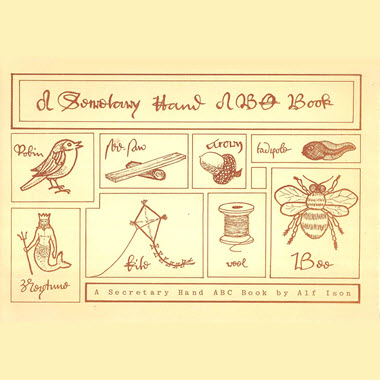
[Ed: Don’t forget that the Society sells Alf Ison’s book on A Secretary Hand, an ABC Book and that there are periodic workshops on reading old handwriting. If you can’t wait for the next workshop we also have a recorded version, in three parts, that you can stream at your leisure.
Click here to buy an access pass for the recorded workshop